

A few years ago, “AI marketing tool” meant a chatbot that could write a mediocre Instagram caption for you. Now it means something closer to hiring a small, tireless team member who never sleeps, never asks for a raise, and occasionally makes a weird mistake you have to catch before it goes live. That’s a big shift, and it’s changed how small business owners think about marketing budgets.
If you run a five-person company, you don’t have a copywriter, a social media manager, an SEO specialist, and a paid ads person sitting in separate offices. You have you, maybe one other person, and a to-do list that never gets shorter. AI tools have become genuinely useful here not because they replace strategy, but because they take the repetitive execution work off your plate so you can spend your limited hours on decisions only you can make.

This isn’t a hype piece. I want to walk through what these tools actually do well, where they fall short, how much they cost, and how to put together a stack that fits a real small business budget instead of a Silicon Valley marketing team’s budget.
Why This Matters More Now Than It Did Two Years Ago
Marketing used to reward whoever had the biggest team. Post more, test more, optimize more win. That math favored big companies with big budgets. AI tools have quietly flattened that curve. A solo founder with a decent AI writing tool and a scheduling app can now put out the volume of content that used to require three employees.
That doesn’t mean quality doesn’t matter anymore. If anything, it matters more, because everyone’s baseline output has gone up. The businesses that win aren’t the ones using AI almost everyone is now they’re the ones using it with a clear point of view about their brand, their customer, and what makes them different. AI can draft the email. It can’t tell you why your customers should care.
There’s also a newer wrinkle worth knowing about: people are starting to ask ChatGPT, Perplexity, and Gemini for recommendations the same way they used to ask Google. Some marketers call this “generative engine optimization,” and while it’s still early, it means how your business shows up in AI-generated answers is becoming almost as important as how you rank in search results. Keep that in the back of your mind as you build out content it’s not a separate job, just a new lens on the same one.
The Main Categories You’ll Actually Need
Rather than listing tools alphabetically, it helps to think in terms of jobs to be done. Here’s how I’d break it down for a small business.
1. Writing and Content Creation
This is where most people start, and for good reason writing takes time, and AI is genuinely good at getting you from a blank page to a workable draft.
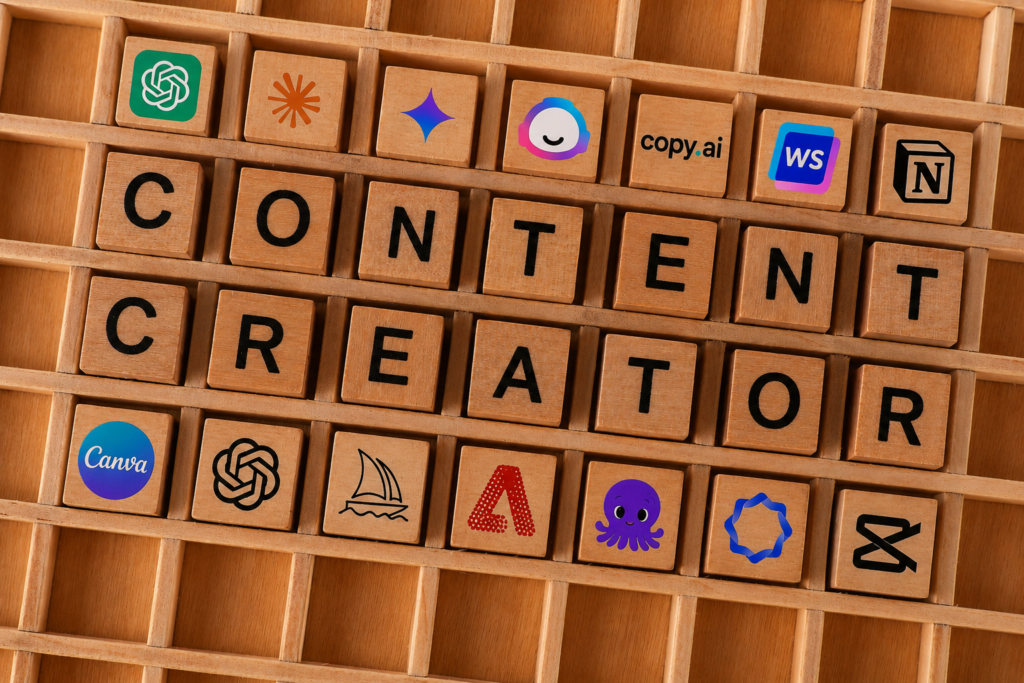
ChatGPT is the obvious starting point for a lot of owners, mostly because it’s flexible and cheap. It’s not built specifically for marketing, but that’s actually part of its appeal — you can use it to brainstorm a campaign, draft an email, write website copy, and then turn around and ask it to help you plan next month’s schedule. The tradeoff is that it has no memory of your brand voice unless you build that context yourself every time, which gets tedious.
Jasper solves that specific problem. It’s built for marketing teams and lets you train it on your brand voice so the output sounds like you instead of sounding like every other business using the same tool. If you’ve ever read a company blog and thought “this reads like it came out of a machine,” it’s often because nobody bothered to give the AI any guardrails. Jasper bakes those guardrails in, which is worth the subscription if you’re publishing regularly.
Copy.ai leans harder into short-form, high-conversion copy captions, product descriptions, ad variations. If your biggest bottleneck is writing dozens of small variations for A/B testing rather than long articles, this is a better fit than a long-form writing tool.
One honest note: whichever tool you use, don’t publish the first draft. Every one of these tools occasionally states things confidently that aren’t true, especially around statistics, dates, or specifics about your own industry. Read everything before it goes out with your name on it.
2. Design and Visual Content
Most small business owners aren’t designers, and hiring one for every social post isn’t realistic.
Canva has become the default here, and it earns that spot. Its AI features let you generate images from a text description, resize one design into ten different formats for different platforms in seconds, and remove backgrounds without touching Photoshop. If you take one thing from this article, it’s this: if you’re still manually resizing graphics for Instagram, LinkedIn, and your website separately, stop. That’s exactly the kind of grunt work these tools exist to kill.

For businesses selling physical products, there’s also a growing category of AI product photography tools that can take a plain photo of your product and place it in a styled scene useful if you can’t afford a proper photoshoot every time you launch something new. Worth exploring if visuals are a bottleneck, but treat the output as a starting point, not a final image, until you’re confident in the quality.
3. SEO
Search traffic is still one of the few marketing channels where the value compounds instead of disappearing the moment you stop paying for it. That makes SEO tools worth the investment even for very small teams.
Surfer SEO is strong specifically for on-page optimization it tells you what a piece of content needs to actually rank, based on what’s already working for that keyword. It’s narrow but does that one job well.
Semrush, on the other hand, covers a wider range: keyword research, competitor tracking, backlink analysis, and site audits. It costs more, and it has a steeper learning curve, but if you want the full picture rather than just content optimization, it’s the more complete tool.
A practical note: don’t buy an SEO tool before you’ve written anything. I’ve seen small businesses subscribe to expensive SEO software and then use it twice because they didn’t have a content plan to plug it into. Get your content rhythm going first with something simpler, then bring in the heavier tool once you’re consistently publishing and want to sharpen your targeting.
4. Email Marketing
Email remains one of the highest-return channels for small businesses, mostly because you own the list nobody can change an algorithm and tank your reach overnight the way they can on social media.

Brevo (formerly Sendinblue) is a solid pick if you want strong email and automation features without paying for a bloated all-in-one platform you’ll never fully use. It handles list segmentation, automated sequences, and AI-assisted subject lines without much complexity.
If you’re already using a CRM like HubSpot, its built-in email tools might cover you without adding another subscription more on that below.
One tip that has nothing to do with AI but matters more than any tool choice: ask your list a real question occasionally. A quick “reply and tell me your biggest marketing headache right now” email tends to boost engagement and gives you material for future content and it reminds your subscribers there’s an actual person behind the sends.
5. Social Media Scheduling and Management
Consistency beats intensity on social media. Posting daily for a month and then vanishing for six weeks does less for you than posting three times a week, every week, indefinitely.
Buffer is a simple scheduling tool that lets you batch your content sit down once a week, load in your posts, and let them go out automatically. It’s not trying to be a full marketing suite, and that’s the point. If your social media strategy has stalled because posting feels like a daily chore, a batching tool like this, paired with an AI writer for captions, usually fixes it within a couple of weeks.
Pairing Canva for visuals with ChatGPT or Copy.ai for captions is a common and genuinely effective combo cheap, fast, and good enough for most small business social accounts.
6. CRM and Customer Relationships
A CRM isn’t just a contact list. A good one with AI features actively helps you sell rather than just storing information.
HubSpot is probably the most common recommendation for small businesses moving from spreadsheets to a real CRM, and it earns that reputation because everything lives in one place your contact history, email campaigns, and marketing automation are all connected, so you’re not stitching together data from three different tools by hand. It has a genuinely useful free tier, and paid plans scale up from there though be careful with contact-based pricing, since costs can climb faster than you expect as your list grows.
Salesforce brings more enterprise-grade power if you’re planning to scale quickly, with AI built into the CRM for things like drafting customer emails and summarizing records automatically. It’s more capable, but also more than most five-person teams need on day one.
7. Automation and Workflow Connections
This is the unglamorous category that quietly saves the most time.
Zapier connects the tools you’re already using so information moves between them without you copying and pasting. New form submission on your website? Zapier can add that person to your email list, notify you on Slack, and create a CRM record, all without you touching anything. Its AI features now let you build these automations by describing what you want in plain language rather than configuring every step manually, which matters if you’re not technical.
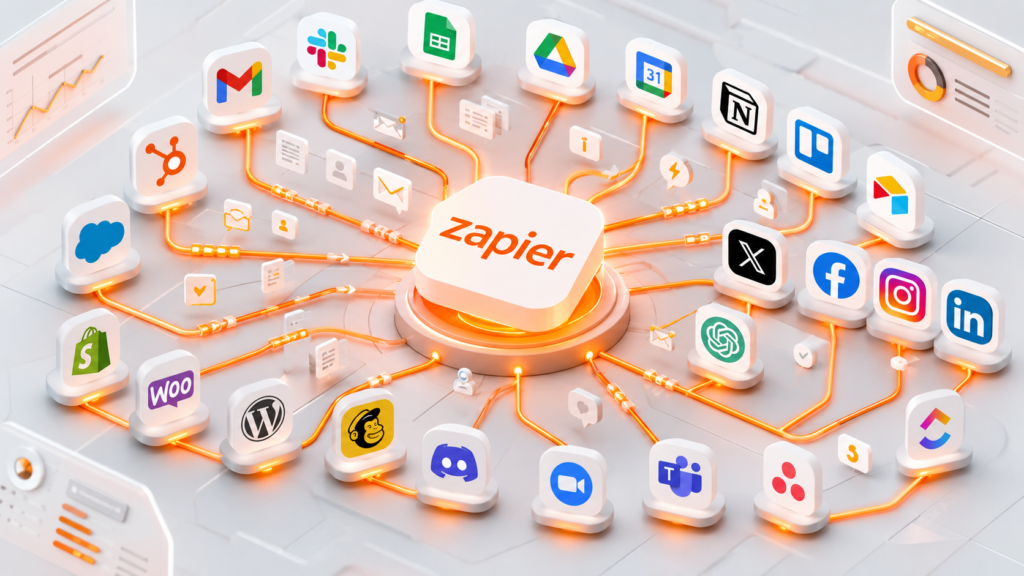
The return on a tool like this isn’t flashy, but it’s real. Every manual step you remove is time you get back permanently, not just once.
8. All-in-One AI Marketing Platforms
A newer category worth mentioning: instead of stitching together five or six separate subscriptions, some platforms now offer a bundle of AI “marketing employees” one focused on content, one on social, one on SEO, one on email working from a shared brand profile so the output stays consistent across channels. For a very lean team, this can genuinely replace several separate tools and several hours of manual coordination between them. The tradeoff is you’re trusting more of your output to fewer humans in the loop, so review cycles matter even more than usual.
Building a Stack That Fits Your Budget
You don’t need all of this on day one. Here’s a rough way to think about it in stages.
If you’re just starting out and money is tight: ChatGPT for writing and brainstorming, Canva for design, Buffer’s free tier for scheduling, and HubSpot’s free CRM tier. That combination costs you close to nothing and covers content, visuals, distribution, and contact management.
Once you have some revenue and a content rhythm: Add Jasper or Copy.ai if brand voice consistency has become a real problem, and bring in a proper SEO tool like Surfer once you’re publishing consistently enough to benefit from optimization.
Once you’re managing enough volume that manual work is genuinely painful: Zapier to connect your tools, Brevo or a fuller CRM email suite for more sophisticated automation, and maybe one of the all-in-one platforms if juggling five subscriptions has become its own job.
The mistake I see most often isn’t picking the wrong too it’s picking too many tools too early. A subscription you use twice a month isn’t saving you money, it’s just a recurring charge with extra steps. Add tools when a specific, recurring task is actually costing you real time, not because a tool looked impressive in a demo.
What AI Still Can’t Do For You
It’s worth being blunt about the limits, because the marketing around these tools tends to oversell them.
AI can’t tell you who your customer actually is. It can help you write to that customer once you’ve figured it out, but the figuring-out part — talking to real customers, noticing patterns, understanding what actually makes them buy is still on you.
It can’t judge tone in context the way a person can. It might write something technically correct that still feels off for your brand, your industry, or the specific moment you’re posting in. A sensitive news cycle, a competitor’s recent misstep, an inside joke your community already has none of that is visible to the tool unless you tell it.
And it can occasionally be confidently wrong, especially about numbers, dates, or claims specific to your business. Every piece of AI-assisted content needs a human read-through before it goes out. That’s not optional, and it’s not really extra work it’s just the editing step that good writing always needed anyway.
The Bottom Line
AI marketing tools have made it realistic for a tiny team to do work that used to require a full department. That’s a genuine advantage if you use it well: pick a small stack that solves problems you actually have, add tools as specific pains show up rather than all at once, and keep a human hand on everything before it reaches a customer.
The tools change fast what’s best in class this year won’t necessarily be best in class next year. But the underlying approach doesn’t change: let AI handle the repetitive execution, and spend your own time on the judgment calls it can’t make for you. That’s still where the real marketing happens.
Learn more about The AI Advantage: Better Marketing for Better Results which helps you know how the Ai advantage. The Complete Guide How AI Is Changing Digital Advertising
thanks for sharing such useful insights about AI and marketing automation agency solutions. This was a helpful read.