
Search is not what it used to be. For two decades, ranking on the first page of Google was the finish line for most marketing teams. Type a keyword, get ten blue links, click the one that looks trustworthy. That pattern is fading fast, and a new discipline called Generative Engine Optimization, or GEO, has stepped in to fill the gap it left behind.
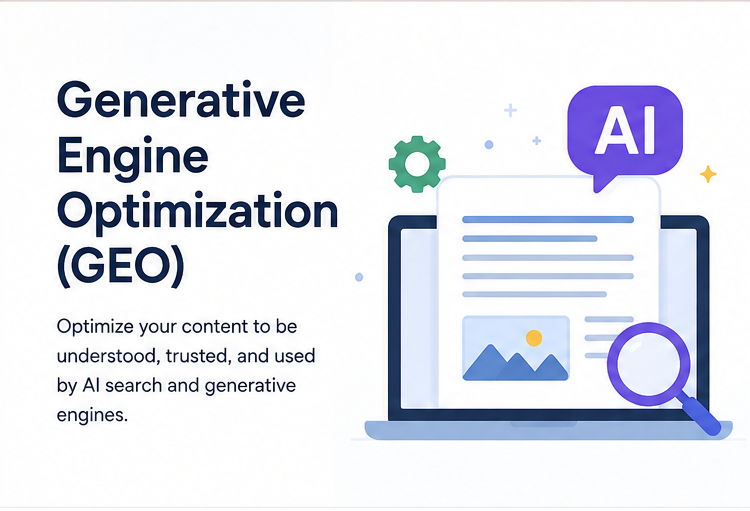
What Generative Engine Optimization Actually Means
GEO is the practice of shaping content so that AI systems can understand it, trust it, and use it when generating an answer to a user’s question. It sounds similar to SEO on the surface, but the mechanics underneath are completely different.
Instead of optimizing for a search algorithm that ranks pages, GEO optimizes for a language model that reads, interprets, and cites information. That means the old playbook of keyword density, backlink volume, and exact match titles carries a lot less weight than it used to. What matters now is whether your content answers a question clearly, whether it is structured in a way a model can parse easily, and whether your brand has enough credible mentions across the web that an AI system recognizes you as a trustworthy source.
HubSpot’s 2026 State of Marketing report put a number on what many marketers already suspected. Half of all consumers now use AI powered search tools as part of their buying journey, and 44 percent of them say it is their main way of discovering new products. Compare that to traditional search engines, which now sit at 31 percent, and it becomes clear why GEO has overtaken SEO in growth rate this year. People are not typing keywords into a search box the same way anymore. They are asking questions to ChatGPT, Gemini, Perplexity, and Google’s AI Overviews, and expecting a direct, conversational answer.
This shift did not happen overnight, but the pace has surprised even seasoned marketers. What used to be a slow, predictable evolution in search behavior turned into a sprint the moment AI chat tools became mainstream. Brands that built their entire growth strategy around keyword rankings are now asking a harder question: how do we get mentioned inside an AI generated answer when there is no ranking position to fight for?
Why the Shift Happened So Quickly
A few forces converged to make this change happen faster than most predicted.
First, the quality of AI answer engines improved dramatically. Early chatbots were unreliable and often made things up. The newer generation is far more accurate, and people have noticed. Once users trust the answer they get from a chat interface, they stop clicking through to ten different websites to verify it themselves.
Second, convenience won. Asking a question in plain language and getting a direct answer is simply faster than scrolling through search results, opening tabs, and comparing pages. For busy people trying to make a decision quickly, whether that is choosing a mattress or picking accounting software, a single clear answer beats ten links to sort through.
Third, the big platforms leaned into this behavior instead of resisting it. Google’s AI Overviews now appear on a huge share of search queries and sit right at the top of the results page, ahead of any organic listing. That single design choice reshaped how billions of searches play out every day, because most people never scroll past what they see first.
Put those three things together and you get a genuine behavior change, not a passing fad. Consumers did not switch to AI search because a marketing campaign convinced them to. They switched because it solved a real problem faster.
The Numbers Behind the Shift
It helps to look at the scale of what has actually happened rather than treating this as a vague industry buzzword.
Half of consumers report using AI powered search as part of their shopping process. Nearly half of those users say it is their primary discovery channel now, ahead of retailer websites and even review sites. That is a massive redistribution of attention away from the channels marketers have spent years optimizing for.
At the same time, AI Overviews now appear on close to half of all tracked search queries, a sharp increase from where they sat just a year earlier. Chat based assistants have also grown their weekly active user counts into the hundreds of millions, and that number keeps climbing.
What makes this especially tricky for marketers is that the AI search market is fragmenting rather than consolidating around one dominant platform. Different assistants pull from different sources. One might lean heavily on a search index, another might use its own retrieval system entirely. That means a brand cannot simply win visibility on one AI platform and assume it carries over everywhere else. A strategy that works well for one engine might do almost nothing for another, which forces marketing teams to think in terms of multiple parallel strategies rather than one unified approach.
Why SEO Alone Is No Longer Enough
None of this means traditional SEO is dead. People still type keywords into search bars, and organic rankings still drive real traffic and revenue for plenty of businesses. But relying on SEO alone now means ignoring a rapidly growing chunk of how people actually find information and make purchase decisions.
The core problem is that SEO was built for an era of ranked lists, and generative engines do not produce ranked lists. A page that ranks number one on Google might not get mentioned at all in an AI generated answer, because the model is not scanning a results page. It is drawing from a broader pool of sources, judging relevance and trustworthiness in a completely different way, and then writing its own summary rather than linking out to yours.
This is why teams that only measure success through keyword rankings are increasingly flying blind. They can be winning the SEO game and still losing the battle for visibility inside AI generated answers, without even realizing it is happening.
SEO Vs GEO
SEO and GEO solve a similar problem in very different ways. SEO exists to help a page rank inside a list of search results. It relies on keywords, backlinks, site speed, and page structure to convince an algorithm that a page deserves a high position among ten blue links. Success is measured by rank. Are you first, are you on page one, did you beat a competitor for a spot.
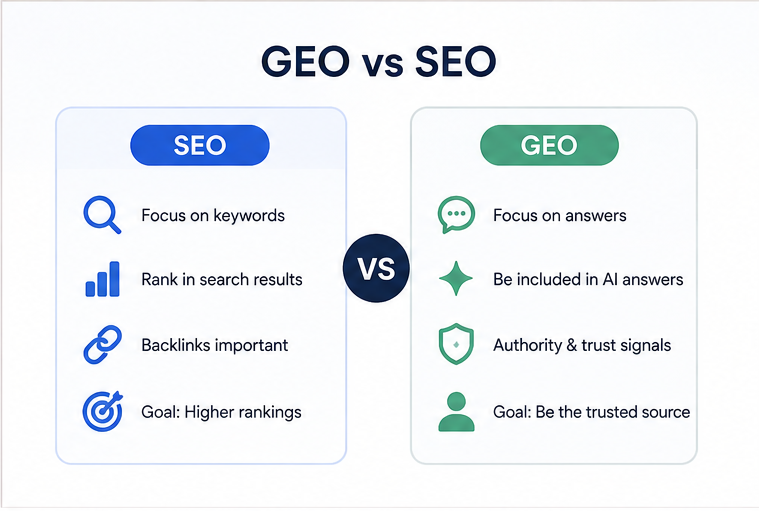
GEO exists for a world where there is no list at all. AI tools like ChatGPT, Gemini, and Google’s AI Overviews generate a single answer pulled from multiple sources, then present it directly to the user. There is no position ten to climb toward. Either a brand gets mentioned inside that answer or it does not exist to that user in that moment.
SEO rewards keyword placement and link volume. GEO rewards clear, direct answers and genuine authority built across the wider web, not just on your own site. SEO still matters because plenty of people type keywords into a search bar. But GEO is becoming necessary because a growing share of people now ask a question once and trust whatever answer comes back, without ever seeing a results page at all.
Building a Practical GEO Strategy
Shifting toward GEO does not require throwing out everything a marketing team already knows. It requires adding new layers on top of solid fundamentals.
Structure Content for Clarity
Generative engines favor content that answers a question directly and early, rather than burying the answer under paragraphs of introduction. A page that states the core answer plainly near the top, then supports it with detail, tends to get pulled into AI generated responses more often than a page that makes the reader dig for the point.
Clear headings, direct language, and well organized sections all help a model parse what a page is actually saying. This is not about writing shorter content. It is about writing content that gets to the point without wasting the reader’s time or the model’s processing effort.
Build Genuine Authority Signals
Because generative engines weigh trust heavily, brand mentions across the wider web matter more than ever. A single well optimized page on your own site is not enough anymore. If other credible sources, industry publications, forums, review sites, and community discussions mention your brand in a positive and accurate way, that reinforces the signal that your brand is a legitimate authority on the topic.
This is a slower process than traditional link building, but it tends to be more durable. Earning genuine mentions across a wide range of trusted sources builds a kind of reputation that is much harder for a competitor to simply copy.
Track New Metrics
Ranking position no longer tells the full story, so marketers need new ways to measure whether their GEO efforts are working. Metrics like citation frequency, how often a brand gets mentioned inside AI generated answers, and referral behavior from AI powered traffic are becoming the new benchmarks.
Some teams are doing this manually, running a batch of common customer questions through different AI assistants and noting whether their brand comes up. Others are starting to use specialized monitoring tools built specifically to track AI visibility. Either approach beats ignoring the problem entirely.
Treat Each Platform Individually
Because ChatGPT, Gemini, Perplexity, and Google’s AI Overviews all pull information differently, a one size fits all approach rarely works well. What earns a citation on one platform might be invisible on another. Marketing teams that want strong coverage across the board need to understand each platform’s quirks rather than assuming success on one guarantees success everywhere.
How It Actually Works
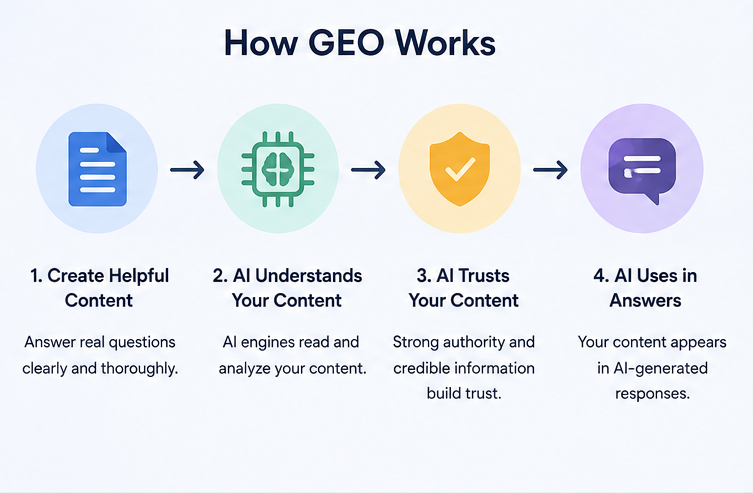
Here’s how the process breaks down according to your image.
1. Create Helpful Content
Everything starts with content that answers real questions clearly and thoroughly. This is the foundation. If the content itself is not genuinely useful, nothing further down the chain works.
2. AI Understands Your Content
Once the content exists, AI engines read through it and analyze what it actually says. This is where structure and clarity matter most, since a model needs to be able to parse the page and pull out the actual answer rather than guess at it.
3. AI Trusts Your Content
After understanding the content, the AI weighs whether it can rely on it. Strong authority signals and credible information are what build that trust. This is the step where mentions across other trusted sites, consistent accuracy, and a solid reputation come into play.
4. AI Uses It in Answers
Once trust is established, the content becomes eligible to actually appear inside AI generated responses. This is the payoff stage, where your brand or content shows up when someone asks a related question through a chat assistant.
The four steps form a straight line rather than a loop. Each stage depends on the one before it. Skip step one by publishing thin or unclear content, and steps two through four never happen, no matter how strong your authority might be elsewhere. The image is essentially showing that GEO is sequential: content quality unlocks comprehension, comprehension unlocks trust, and trust unlocks visibility inside AI answers.
What This Means for Small Businesses
Larger companies with big marketing budgets are not the only ones who can compete here. In some ways, GEO levels the playing field more than traditional SEO ever did.
Ranking well on Google historically rewarded domain age, backlink volume, and years of accumulated authority, all things a small challenger brand struggles to match quickly. GEO leans more heavily on genuine expertise, clear answers, and authentic mentions across the web. A smaller company with deep knowledge in its niche and an engaged community around it can earn visibility inside AI answers faster than it ever could climb a competitive Google ranking.
This does not mean it is easy. It still takes real effort to build the kind of credible presence that gets picked up by AI systems. But the barrier to entry looks different than it used to, and that is worth paying attention to for anyone running a smaller operation without a massive marketing budget.
Looking Ahead
The shift toward AI powered search is not a temporary trend that will fade once the novelty wears off. The underlying behavior change, people preferring a direct answer over a list of links to sort through, reflects a genuine improvement in convenience, and people rarely give up convenience once they get used to it.
That said, the tools and best practices around GEO are still evolving quickly. What works today might need adjusting in six months as these platforms refine how they pull and present information. Marketing teams that stay flexible, keep testing, and treat GEO as an ongoing practice rather than a one time project will be the ones who stay visible as this space continues to shift.
The businesses that figure this out early are not just chasing another marketing fad. They are adapting to how their customers actually search for answers now, and that adaptation is quickly becoming the difference between being found and being invisible.
To know about the local SEO learn The Complete Guide to Local SEO for Pakistani Businesses or to rank your business on google How to Optimize Your Google Business Profile: https://cpowerpak.com/how-to-optimize-your-google-business-profile-complete-guide/Complete Guide