
Running a Google Ads account looks simple from the outside. You pick some keywords, write an ad, set a budget, and wait for the sales to roll in. Anyone who has actually managed a campaign for more than a few weeks knows this is not how it works. Google Ads is one of the most powerful tools a business can use to find new customers, but it is also one of the easiest ways to burn through a marketing budget without getting anything back.
Most of the money wasted in Google Ads does not disappear because the platform is broken or because competition is too fierce. It disappears because of mistakes that are completely avoidable once you know what to look for. Some of these mistakes are made by beginners who are still learning the platform. Others are made by experienced marketers who set up a campaign once and never look at it again. Below are the most common and most expensive mistakes we see, and how to fix each one.
1. Ignoring Negative Keywords
If there is one habit that separates profitable accounts from accounts that leak money, it is the use of negative keywords. A negative keyword tells Google which searches you do not want your ad to show up for. Without them, your ads can appear for searches that have nothing to do with what you actually sell.
Say you run a business that sells premium leather office chairs. If you are bidding on the keyword “office chairs” without any negative keywords attached, your ad might show up for searches like “cheap office chairs,” “free office chair,” or “office chair repair.” None of those searchers are likely to buy a premium product from you, yet every click on your ad still costs money.
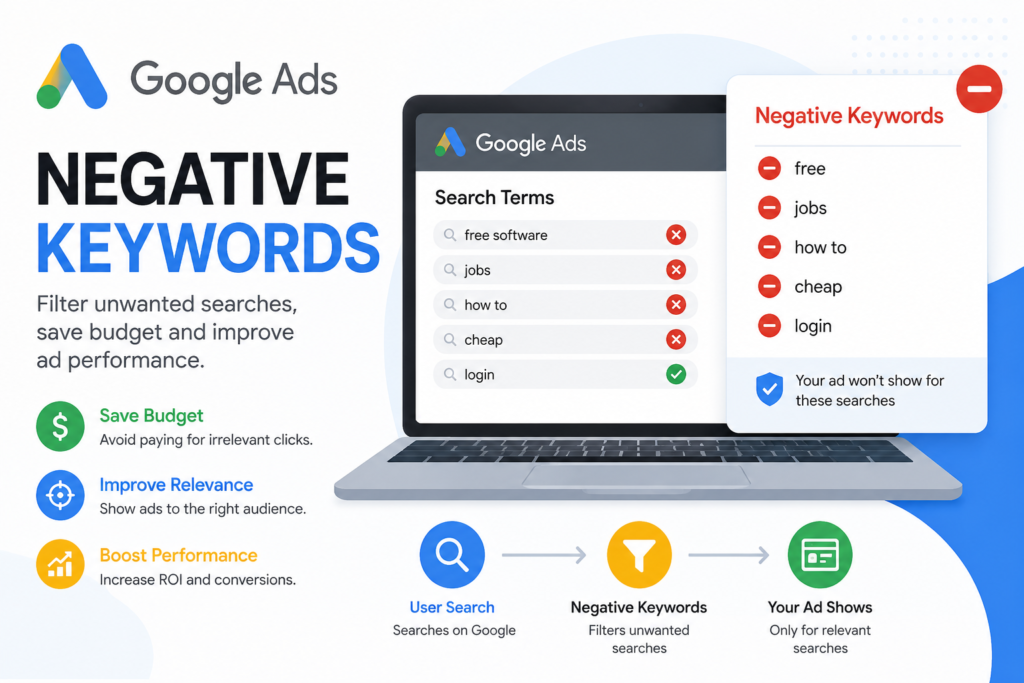
The fix requires ongoing attention rather than a one-time setup. Every week or two, pull up the search terms report inside your campaign and look at the actual phrases people typed before clicking your ad. You will almost always find a handful of irrelevant terms hiding in there. Add them as negative keywords and your click quality improves immediately — a single habit that alone can save hundreds or even thousands of dollars a month, depending on the size of the account.
2. Using Broad Match Without a Strategy
Broad match keywords tell Google to show your ad for any search it considers related to your keyword, even if the wording is completely different. This match type can work well, but only when it is paired with strong negative keyword lists and careful monitoring. Turning on broad match and assuming the algorithm will sort out the right audience on its own is a common and costly shortcut.
The result is often a flood of clicks from searches that are only loosely connected to the actual product or service being advertised. A plumbing company bidding broadly on “pipe repair” might end up paying for clicks related to pipe manufacturing, pipe organs, or DIY pipe tutorials that have zero commercial intent.
Broad match is not something to avoid entirely, but it needs guardrails. Pairing it with smart bidding strategies trained on real conversion data, along with a strict and growing negative keyword list, keeps this match type from turning into an expensive experiment.
3. No Conversion Tracking Set Up Properly
This mistake sits quietly under the surface and causes damage that is hard to notice until you look closely. Campaigns often launch without properly configured conversion tracking, or it gets set up once and never gets checked again after a website update quietly breaks it.
Without accurate conversion data, you are essentially flying blind. You cannot tell which keywords, ads, or audiences are actually driving sales or leads. Decisions end up based on gut feeling or vanity metrics like click-through rate, when in reality those numbers say almost nothing about whether a campaign is profitable.
Before spending another dollar on ads, confirm that conversion tracking is firing correctly. Test it yourself by completing a purchase or filling out a form and checking that it shows up in the Google Ads interface. If you are using Google Analytics alongside Google Ads, make sure the two are properly linked so that data flows correctly between both platforms.
4. Poor Account Structure
A messy account structure does not look dangerous at first glance, but it slowly drains performance over time. Cramming dozens of unrelated products or services into a single ad group, or worse, into a single campaign, makes it nearly impossible to write ads that feel relevant to every search, and it confuses Google’s algorithm as it tries to optimize bids.
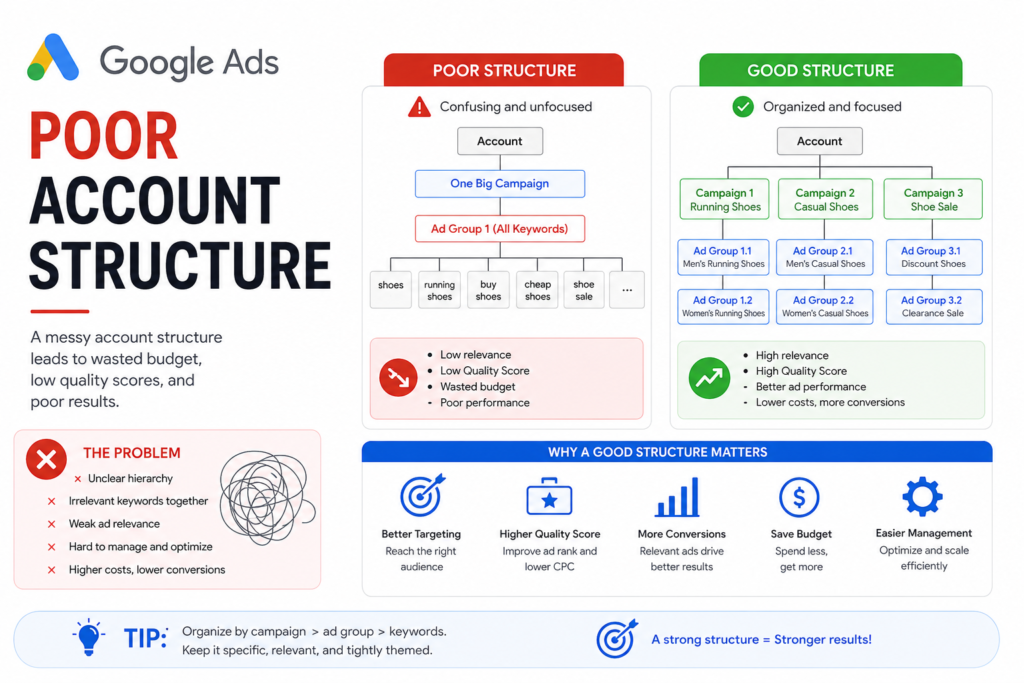
A well-structured account groups keywords by theme, with each ad group containing a tight cluster of closely related terms. This allows you to write ad copy that speaks directly to what the searcher is looking for, which improves both click-through rate and Quality Score. A better Quality Score means a lower cost per click, which directly affects your bottom line.
If your account currently has ad groups with fifty or more unrelated keywords stuffed together, it is worth taking the time to reorganize. It is tedious work, but the payoff in performance is usually significant.
5. Not Writing Enough Ad Variations
Writing a single ad for an ad group and never touching it again is a missed opportunity. Google rewards accounts that provide multiple ad variations because it allows the system to test different headlines and descriptions to see what resonates with searchers.
Responsive search ads, now the standard ad format in Google Ads, let you add multiple headlines and descriptions that Google mixes and matches automatically. Filling in only the minimum number leaves performance on the table. Providing a full set of well-written, varied headlines and descriptions gives Google more material to test, which usually leads to better results over time. It also helps to periodically review which headlines and descriptions are marked as performing well inside the ad strength report, and to pause or replace the ones that are consistently weak.
6. Sending Traffic to a Weak Landing Page
You can have the best keyword targeting and the most compelling ad copy in the world, but if the landing page does not match what was promised in the ad, the click was wasted money. This is one of the most common and most costly mistakes advertisers make.
A landing page needs to load quickly, look trustworthy, and clearly continue the message that brought the visitor there in the first place. If your ad promises a discount on winter coats, the landing page should show winter coats and that discount front and center, not a generic homepage that requires three more clicks to find what was advertised.
Mobile performance matters here too. A huge portion of search traffic comes from phones, and a landing page that is slow to load or difficult to navigate on a small screen will drive potential customers away before they ever see what you are offering.
7. Ignoring the Search Terms Report
We touched on this earlier in the context of negative keywords, but it deserves its own mention because so many advertisers simply never open this report. The search terms report shows the exact words and phrases that triggered your ad to appear. It is one of the most valuable sources of information available inside the entire platform, yet it often goes completely unchecked for months.
Reviewing this report regularly does more than help you find negative keywords. It also reveals new keyword opportunities you had not thought of, shows you how people naturally phrase their searches, and gives insight into what stage of the buying process your traffic is coming from. Treating this report as a routine part of account management, rather than an afterthought, noticeably improves efficiency over time.
8. Setting and Forgetting Budgets
Budgets are not something you set once and leave alone forever. Seasonal trends, changes in competition, and shifts in your own business goals all affect how much you should be spending and where that spending should go. Treating a budget as a fixed number often leads to underspending during high-opportunity periods, or overspending when demand is naturally low.
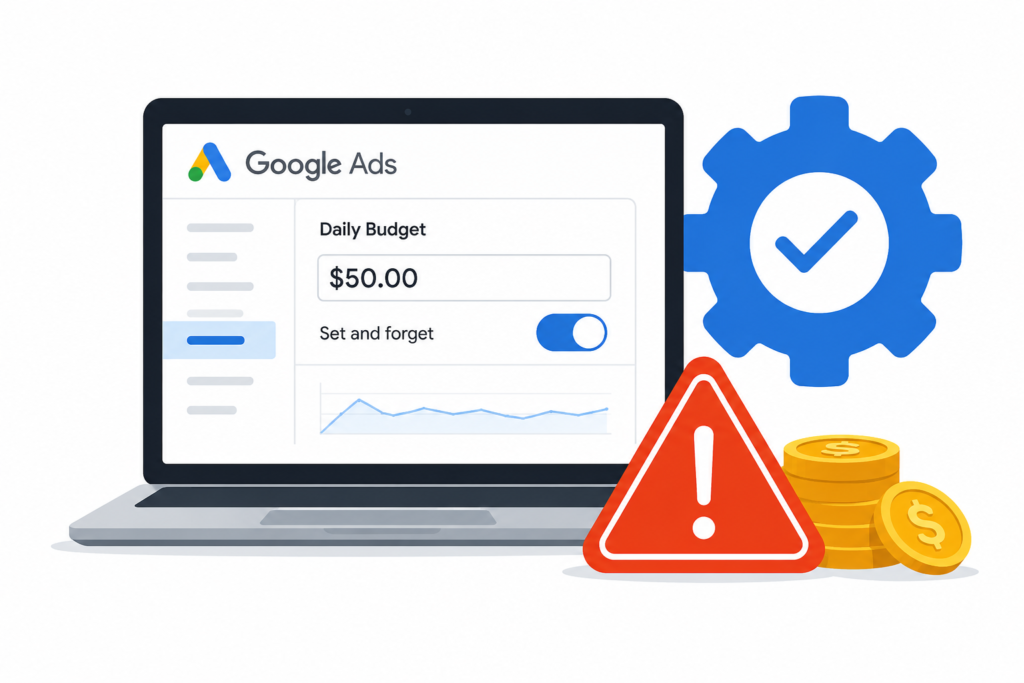
It helps to review budget allocation at least once a month. Look at which campaigns are consistently limited by budget and missing out on potential traffic, and which campaigns are spending more than they should relative to the results they produce. Shifting budget toward what is working and away from what is not should be a continuous process, not a one-time decision.
9. Relying Too Heavily on Automated Bidding Too Early
Google’s automated bidding strategies, such as Maximize Conversions or Target CPA, can be extremely effective once an account has enough historical data for the algorithm to learn from. Switching to fully automated bidding before the account has any meaningful conversion history is where things tend to go wrong.
Automated bidding strategies need data to make good decisions. A brand-new campaign with only a handful of conversions does not give the algorithm enough information to optimize properly, which often leads to wasted spend during the learning phase. In these early stages, manual bidding or a more conservative automated strategy tends to give better control until enough conversion data has accumulated to justify handing more control over to the algorithm.
10. Ignoring Ad Extensions
Ad extensions, now often called assets inside the Google Ads interface, add extra information to your ads such as sitelinks, callouts, structured snippets, and phone numbers. Many accounts either never set these up or set them up once and forget about them entirely.
These extensions increase the amount of space your ad takes up on the results page, provide additional information that can influence a decision to click, and in many cases improve your ad rank and lower your cost per click. Leaving them blank essentially gives up free real estate that could be working in your favor. Taking the time to fill out sitelinks with specific, useful destinations, along with callouts that highlight real benefits of your business, is a simple change that often produces a noticeable improvement — and unlike some fixes on this list, it typically takes less than an hour to do.
11. Not Segmenting by Device, Location, or Time
Not every customer behaves the same way, and treating all traffic identically regardless of when or how it arrives is a mistake that costs more money than most advertisers realize. A campaign might perform beautifully on desktop during business hours but perform poorly on mobile late at night. Without reviewing performance broken down by device, location, and time of day, these patterns stay hidden.
Once you identify where performance dips, you can adjust bids accordingly. This might mean increasing bids during hours when your team is available to respond to leads quickly, or reducing bids in regions that generate clicks but rarely convert into paying customers. This kind of fine-tuning takes time to notice, but the compounding savings over months can be substantial.
12. Skipping Remarketing
A large percentage of website visitors do not convert on their first visit, regardless of how good the ad or landing page might be. Skipping remarketing means missing an opportunity to reach people who have already shown interest in what you offer.
Remarketing campaigns tend to have lower costs and higher conversion rates compared to cold traffic campaigns, because you are speaking to an audience that already knows who you are. Setting up even a basic remarketing list to show ads to recent website visitors is a low-effort, high-value addition that gets overlooked far more often than it should.
13. Not Reviewing Quality Score Factors
Quality Score is Google’s way of measuring how relevant your keywords, ads, and landing pages are to the people searching. A higher Quality Score generally means a lower cost per click and better ad positioning, while a low Quality Score means paying more for less visibility.
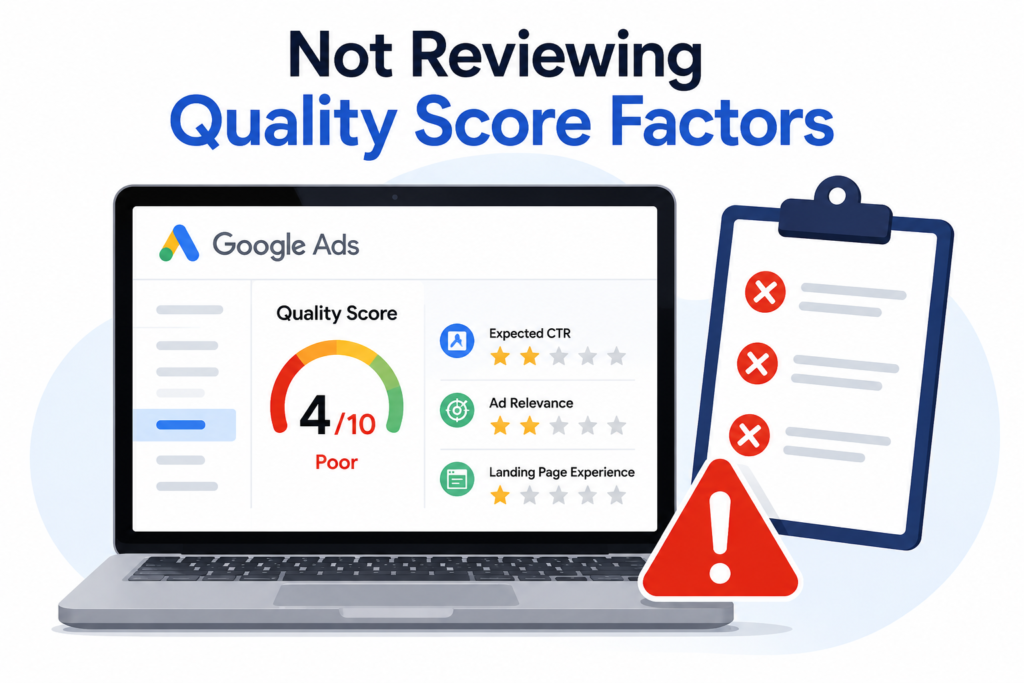
This metric goes unchecked far more often than you’d expect, largely because the factors behind it aren’t well understood. Expected click-through rate, ad relevance, and landing page experience all play a role. If your Quality Score is consistently low across an account, the fix usually involves tightening ad group themes, writing more relevant ad copy, and improving landing page alignment, rather than simply raising your bid to compensate.
14. Copying Competitor Strategies Without Understanding Context
It is common to look at what a competitor is doing and try to replicate it directly, assuming that if it works for them it will work the same way for everyone else. The problem is that every business has different margins, different customer lifetime value, and different conversion rates. What looks like an aggressive and successful strategy for one company might be financially unsustainable for another.
Rather than copying tactics blindly, it helps to understand the reasoning behind a strategy before adopting it. A competitor bidding aggressively on broad terms might have a much higher average order value that justifies the spend — something that would not apply to a business with tighter margins.
15. Not Testing Landing Pages and Ad Copy Systematically
Writing one ad and building one landing page, then never testing alternatives, means never really knowing whether a different headline, a different offer, or a different page layout could produce meaningfully better results.
Simple split testing, even something as basic as testing two different headlines against each other for a few weeks, can reveal surprising insights about what actually resonates with your audience. Over time, this habit of continuous testing compounds into significant improvements in overall account performance.
Bringing It All Together
Google Ads rewards businesses that treat it as an ongoing process rather than a one-time setup. Every mistake covered here shares a common thread: they all stem from a lack of regular attention and review. Negative keywords need updating, search terms need checking, budgets need adjusting, and ad copy needs testing. None of these tasks are particularly difficult on their own, but skipping them consistently is what causes wasted spend to pile up month after month.
If you recognize your own account in several of these mistakes, do not feel discouraged. Nearly every business that runs ads long enough falls into a few of these traps at some point. What matters is building the habit of regular review and being willing to make small adjustments based on real data rather than assumptions. Over time, these small corrections add up to a campaign that spends less while delivering more, which is ultimately the entire point of running paid advertising in the first place.
Taking even one afternoon a month to work through these areas — checking search terms, reviewing Quality Score, testing a new headline, and adjusting budgets based on what the data shows — can transform an account that has been quietly losing money into one that finally earns its place in your marketing budget.
Not sure where your account stands? Start with the search terms report and the conversion tracking check from this list — they take under an hour and usually surface the biggest leaks first.
Want to learn more about how meta ad works? How Digital Marketing Double Your Sales: Simple Strategies and The Benefits of Professional Social Media Page Management